
Quick Summary
Mass loaded vinyl is a dense, flexible sound barrier designed to reduce airborne noise transmission through walls, ceilings, floors, and partitions.
A properly installed mass loaded vinyl sheet helps create a continuous acoustic barrier by minimizing gaps, joints, and sound leakage paths.
Effective mass loaded vinyl soundproofing works best as part of a layered acoustic assembly with insulation, boards, sealing, and decoupling.
This guide covers installation steps, application areas, common mistakes, and practical tips for achieving better acoustic performance.
Why Mass Loaded Vinyl Is Becoming a Go-To Sound Barrier
Modern buildings are designed to look impressive, but visual comfort is only one part of a successful interior. Acoustic comfort has become equally important in workplaces, hospitality spaces, healthcare facilities, educational institutions, studios, residential developments, and commercial buildings.
This is where mass loaded vinyl becomes valuable.
Unlike sound-absorbing materials that primarily reduce reflections within a room, mass loaded vinyl works mainly as a sound-blocking barrier. Its high density helps resist the transmission of airborne sound through building elements.
A properly installed mass loaded vinyl sheet can be incorporated into wall, ceiling, floor, and partition assemblies without requiring a major increase in structural depth.
The real advantage of mass loaded vinyl soundproofing is its ability to complement other acoustic materials. Rather than relying on a single material, designers can create a layered acoustic assembly where each component performs a specific function.
Think of it as an acoustic strategy rather than simply another building material.
What Is a Mass Loaded Vinyl Sheet?
A mass loaded vinyl sheet is a flexible, dense acoustic barrier manufactured primarily to reduce sound transmission. Its flexibility allows it to conform to different surfaces, while its mass helps interrupt airborne sound movement through an assembly.
The material is generally supplied in rolls or sheets, making it suitable for large-area applications.
Depending on the project requirement, a mass loaded vinyl sheet can be positioned behind wall finishes, between layers of gypsum boards, above ceilings, below floors, or within partition systems.
The basic acoustic principle
Sound travels through building assemblies as vibration and airborne energy. Increasing the mass and improving the separation of layers can make it more difficult for sound energy to pass from one space to another.
This is why mass loaded vinyl soundproofing is often used alongside:
- Gypsum boards
- Mineral wool or fiberglass insulation
- Acoustic panels
- Resilient channels
- Suspended ceiling systems
- Floating floor assemblies
- Partition systems
- Sealing compounds
The objective is not simply to add material. It is to create a continuous and well-sealed acoustic barrier.
Mass Loaded Vinyl Soundproofing: Barrier vs. Absorber
One of the most common misunderstandings in acoustic design is treating sound blocking and sound absorption as the same thing.
They are not.
Mass loaded vinyl soundproofing primarily addresses sound transmission. Acoustic absorbers, meanwhile, help control reverberation, reflections, echo, and overall room acoustics.
For example, consider a meeting room located next to a busy workspace. Acoustic wall panels inside the meeting room may improve speech clarity and reduce internal reflections. However, they may not be sufficient to prevent conversations from travelling into the adjacent workspace.
A mass loaded vinyl sheet incorporated within the partition can provide an additional sound-barrier layer.
This distinction helps architects, designers, contractors, and project consultants select the right acoustic strategy for the actual problem.
Before Installation: Get the Assembly Right
A successful mass loaded vinyl installation begins before the first sheet is cut.
The acoustic performance of a system depends on the complete assembly, not just the barrier itself.
Before installation, evaluate:
1. Identify the noise source
Determine whether the primary issue is:
- Speech
- Equipment noise
- HVAC noise
- Traffic
- Mechanical vibration
- Music
- Impact noise
- General airborne sound transmission
This helps determine the appropriate acoustic construction.
2. Inspect the surface
The substrate should be reasonably clean, dry, stable, and free from protruding elements that could damage the material.
3. Plan the coverage
Measure the installation area and plan sheet placement before cutting. The objective should be continuous coverage with minimal unnecessary joints.
4. Identify penetrations
Electrical boxes, ducts, pipes, switches, doors, access panels, and other penetrations can become weak points in an acoustic assembly.
Even a high-performance mass loaded vinyl sheet cannot compensate for poorly treated openings.
Step-by-Step Mass Loaded Vinyl Sheet Installation
Step 1: Prepare the Installation Area
Start by cleaning and inspecting the surface. Remove dust, loose particles, sharp projections, and unnecessary obstructions.
For wall applications, check the framing and cavity arrangement. For ceilings, ensure that the supporting system is ready. For floor applications, verify that the substrate is suitable for the intended assembly.
Proper preparation helps the mass loaded vinyl sheet sit flat and remain securely positioned.
Step 2: Measure and Cut Carefully
Measure the installation area and determine the required sheet dimensions.
When cutting mass loaded vinyl, use suitable cutting tools and follow the manufacturer’s handling recommendations.
Avoid excessive small pieces wherever possible. Large, continuous sections are generally preferable because every joint represents another location that needs to be carefully sealed.
A useful installation principle is:
Plan the layout first. Cut second. Fix third. Seal last.
This simple sequence can reduce material wastage and installation errors.
Step 3: Position the Mass Loaded Vinyl Sheet
Place the mass loaded vinyl sheet over the intended surface or within the selected assembly.
Depending on the application, it may be installed:
- Behind gypsum board
- Between wall layers
- Inside stud cavities
- Above ceiling systems
- Beneath floor finishes
- Within partition assemblies
Ensure that the material is properly aligned and does not contain unnecessary folds or unsupported sections.
For mass loaded vinyl soundproofing, continuity is critical. The barrier should cover the intended area without leaving unplanned gaps.
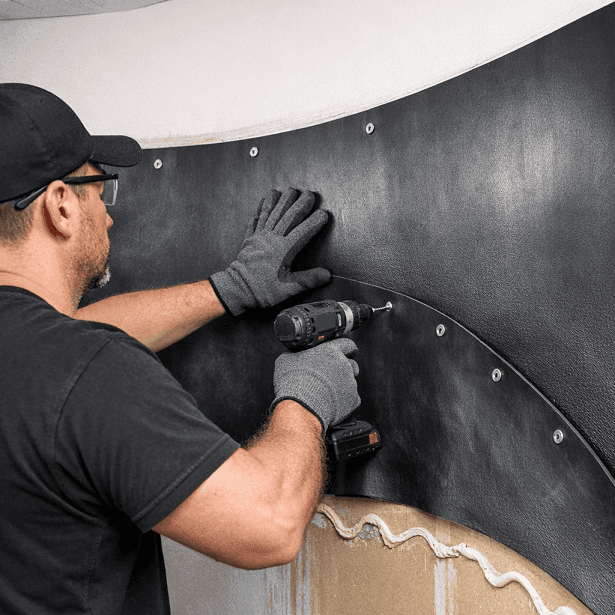
Step 4: Secure the Material
The fixing method depends on the substrate and assembly design.
Mechanical fasteners, suitable adhesives, or other approved fixing approaches may be used according to the manufacturer’s installation recommendations.
The purpose of fixing is to keep the mass loaded vinyl sheet stable during subsequent construction.
Avoid creating unnecessary holes in the material. Every penetration should be considered carefully because excessive or untreated penetrations can compromise acoustic continuity.
Step 5: Overlap and Treat the Joints
Joints deserve special attention.
Two correctly installed mass loaded vinyl sections should form a continuous acoustic barrier. Where overlaps or joints are required, they should be treated according to the manufacturer’s recommended installation method.
Acoustically rated sealants or appropriate joint treatments can help reduce air leakage.
Remember:
A sound barrier is only as strong as its weakest gap.
This is particularly important around corners, edges, service penetrations, junctions, and transitions between different building elements.
Step 6: Seal the Perimeter and Penetrations
Perimeter sealing is one of the most important parts of mass loaded vinyl soundproofing.
Inspect:
- Wall-to-floor junctions
- Wall-to-ceiling junctions
- Corners
- Electrical penetrations
- Pipe openings
- HVAC penetrations
- Door and frame interfaces
- Service openings
Use compatible acoustic sealing solutions as specified for the assembly.
The goal is to reduce unwanted air paths through which sound can travel.
Installation by Application
Mass Loaded Vinyl for Walls
Wall applications are among the most common uses of mass loaded vinyl.
A typical acoustic wall may combine framing, insulation, a mass loaded vinyl sheet, and one or more layers of board.
The exact assembly should be designed according to the required acoustic performance, structural conditions, fire requirements, and project specifications.
For offices, conference rooms, hospitality spaces, studios, healthcare areas, and residential projects, wall-mounted mass loaded vinyl soundproofing can help improve separation between adjoining spaces.
Mass Loaded Vinyl for Ceilings
Noise can travel between floors as well as between adjacent rooms.
A mass loaded vinyl sheet can be incorporated into ceiling assemblies to improve resistance to airborne sound transmission from spaces above or below.
It may be used alongside acoustic insulation and gypsum-based ceiling systems depending on the project requirements.
For commercial buildings, this approach can be particularly useful where meeting rooms, private offices, classrooms, hotel rooms, or other noise-sensitive areas are positioned near one another.
Mass Loaded Vinyl for Floors
Floor assemblies can also benefit from dense acoustic barriers.
When used as part of a properly designed floor system, mass loaded vinyl can contribute to controlling airborne sound transmission.
However, floor acoustic performance also depends on impact isolation, structural connections, floor finishes, underlays, and the complete floor-ceiling construction.
Therefore, mass loaded vinyl soundproofing should be considered as one component within the larger acoustic assembly rather than an independent solution for every type of floor noise.
Common Installation Mistakes to Avoid
Even premium acoustic materials can underperform when installation quality is poor.
Avoid these common mistakes:
- Leaving gaps:
Small untreated gaps can create direct sound paths.
- Ignoring penetrations:
Electrical, HVAC, plumbing, and service openings require careful acoustic treatment.
- Using too many small pieces:
Excessive joints increase installation complexity and potential weak points.
- Incorrect fixing:
Improper fixing can cause movement, sagging, or installation difficulties.
- Skipping perimeter sealing:
Untreated edges can undermine the continuity of the acoustic barrier.
- Confusing absorption with sound blocking:
A decorative acoustic panel cannot always replace a sound barrier when the primary issue is transmission between spaces.
- Ignoring the complete assembly:
The performance of mass loaded vinyl soundproofing depends on how the material works with the surrounding construction.
How to Improve Mass Loaded Vinyl Soundproofing Performance
The most effective acoustic systems usually follow a layered approach.
A high-performance assembly may combine:
- Mass – a dense barrier such as a mass loaded vinyl sheet
- Absorption – insulation within a cavity
- Decoupling – reducing direct structural connections where appropriate
- Sealing – controlling air leakage at joints and penetrations
- Additional mass – suitable board or finishing layers
This combination addresses different sound transmission mechanisms.
For architects and designers, this means the question should not simply be, “Where can we install mass loaded vinyl?”
Instead, ask:
“How can we integrate the acoustic barrier into the complete building assembly?”
That shift in thinking can lead to more effective and practical acoustic solutions.
Where Can Mass Loaded Vinyl Be Used?
The versatility of mass loaded vinyl makes it suitable for a broad range of applications, including:
- Corporate offices
- Conference rooms
- Recording and media spaces
- Educational institutions
- Healthcare facilities
- Hotels and hospitality projects
- Residential interiors
- Home theatres
- Industrial environments
- Commercial partitions
- HVAC and mechanical enclosures
- Noise-sensitive architectural spaces
Its flexible format also makes a mass loaded vinyl sheet practical for integrating acoustic barriers into assemblies where rigid materials may be difficult to install.
Choosing the Right Acoustic Approach
Before specifying mass loaded vinyl soundproofing, project teams should consider several factors.
Acoustic requirement
What level and type of sound transmission needs to be controlled?
Building assembly
Is the solution being installed in a wall, ceiling, floor, partition, or enclosure?
Installation conditions
Does the material need to work around existing services, corners, framing, or restricted spaces?
Fire and building requirements
The complete assembly should comply with applicable project specifications and local requirements.
Compatibility
The mass loaded vinyl sheet should be compatible with adjacent materials and the proposed fixing method.
Testing and performance
Where required, select assemblies supported by relevant acoustic testing and technical documentation rather than evaluating a material in isolation.
Why Installation Quality Matters More Than You Think
One of the biggest lessons in acoustic construction is that material selection and workmanship must work together.
A well-designed mass loaded vinyl soundproofing system can lose effectiveness when joints are poorly treated, penetrations remain open, or the material is installed inconsistently.
That is why successful acoustic design should involve collaboration between:
- Architects
- Interior designers
- Acoustic consultants
- Project management consultants
- Contractors
- Building material specialists
At Tranquil Global, the focus should not simply be on supplying acoustic material. The larger objective is to help project teams understand how acoustic products can become part of an integrated building solution.
The Smarter Way to Specify Mass Loaded Vinyl
The future of acoustic design is moving beyond isolated product selection.
Architects and designers are increasingly looking at performance, occupant comfort, durability, aesthetics, sustainability, installation efficiency, and lifecycle value together.
In this context, mass loaded vinyl offers an important advantage: it can become an unobtrusive acoustic layer within a larger architectural system.
When combined with acoustic insulation, resilient construction, gypsum boards, ceiling systems, and proper sealing, a mass loaded vinyl sheet can contribute to a more comprehensive sound-control strategy.
The key is simple:
Don’t design around a product. Design around the acoustic outcome.
Frequently Asked Questions
- What is mass loaded vinyl used for?
Mass loaded vinyl is primarily used as a dense sound barrier to reduce airborne sound transmission through walls, ceilings, floors, partitions, and other building assemblies.
- Is mass loaded vinyl the same as an acoustic panel?
No. A mass loaded vinyl sheet is primarily a sound-blocking barrier, while acoustic panels are generally designed to absorb sound reflections and control reverberation within a room.
- Where can mass loaded vinyl be installed?
It can be incorporated into wall, ceiling, floor, partition, enclosure, and other building assemblies, subject to the project’s construction and acoustic requirements.
- Does mass loaded vinyl need to cover the entire surface?
For effective mass loaded vinyl soundproofing, continuity of the intended barrier area is important. Gaps, untreated joints, and penetrations can create sound paths and reduce overall system performance.
- Can mass loaded vinyl be combined with other acoustic materials?
Yes. Mass loaded vinyl is often used as part of a layered acoustic assembly alongside insulation, gypsum boards, resilient systems, acoustic panels, and suitable sealing solutions.
Click to Explore More
MLV Soundproofing Trends Transforming Workplace Acoustics in 2026
Explore how evolving workplace design priorities are influencing the adoption and specification of MLV-based acoustic solutions.
Build Better Acoustic Spaces with Tranquil Global
Effective mass loaded vinyl soundproofing is not simply about adding a dense material to a wall or ceiling. It is about understanding how sound moves, identifying weak points, designing the right assembly, and executing every layer with precision.
From material selection to installation planning, the right acoustic strategy can help create spaces that are quieter, more comfortable, and better suited to their intended purpose.
Looking for the right acoustic solution for your next project?
Connect with Tranquil Global for your acoustic material and project requirements, and explore solutions designed to bring better acoustic performance to modern architectural spaces.