
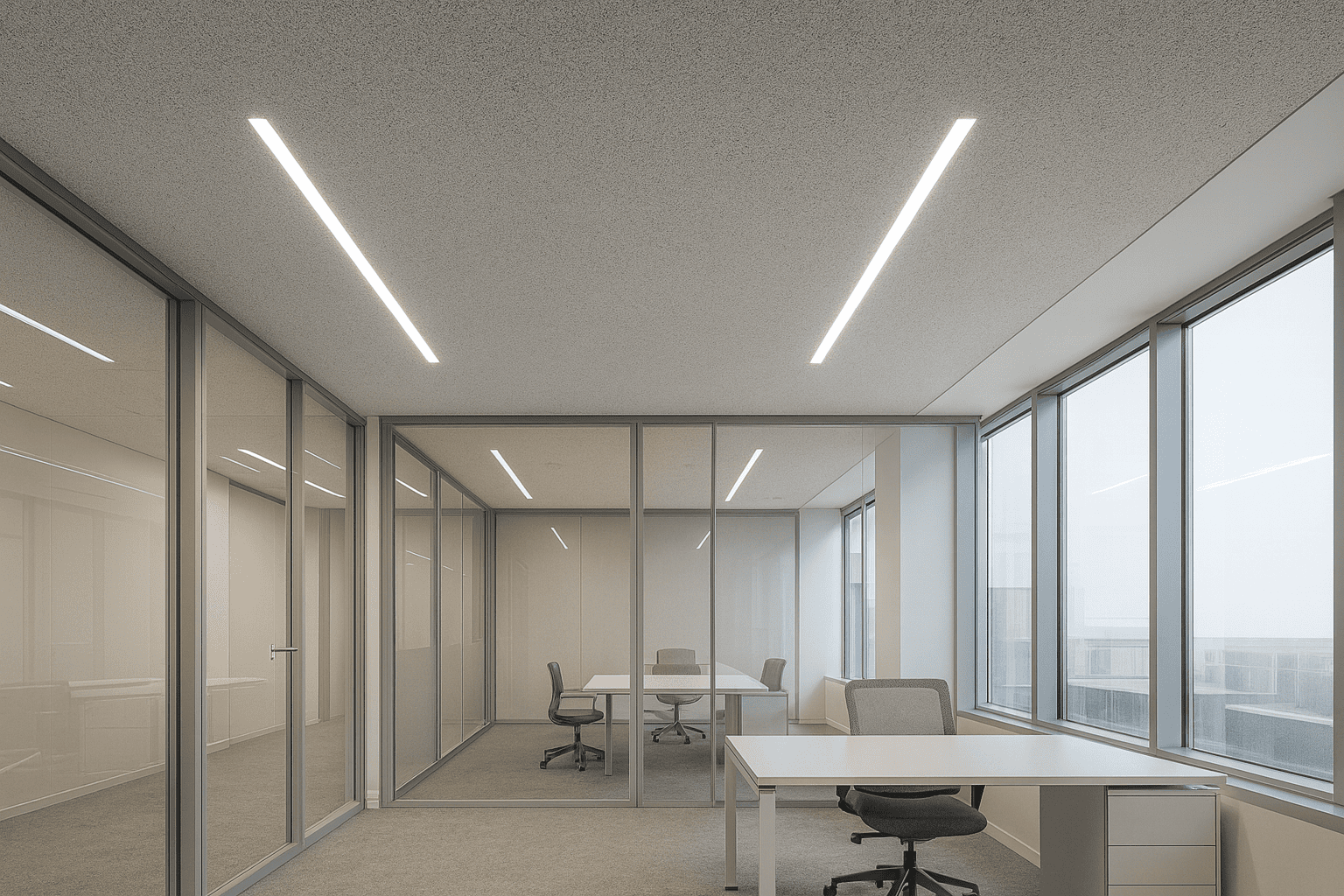
Quick Summary
- Acoustic spray is a practical surface treatment designed to help control unwanted sound reflections and reverberation within a room.
- Unlike conventional decorative coatings, acoustic spray paint and spray-based acoustic finishes can combine visual flexibility with sound-absorbing properties.
- Their effectiveness depends on factors such as material composition, thickness, ceiling area, room volume, and overall acoustic design.
- From offices and educational spaces to hospitality and commercial interiors, acoustic spray solutions can be a valuable part of a well-planned acoustic strategy.
What Is Acoustic Spray and How Does It Work?
Modern interiors are expected to deliver more than visual appeal. They need to be comfortable, functional, productive, and acoustically balanced. In open offices, meeting rooms, restaurants, auditoriums, educational spaces, and commercial environments, excessive reverberation can quickly become a problem.
This is where acoustic spray enters the picture.
An acoustic spray is a spray-applied sound-absorbing material designed to reduce the reflection of sound from building surfaces. When applied to suitable ceilings or other surfaces, its porous structure helps absorb a portion of the sound energy rather than allowing it to bounce repeatedly around the room.
The result can be:
- Reduced reverberation
- Better speech intelligibility
- Lower perceived noise levels
- Improved acoustic comfort
- A more controlled sound environment
However, an important point should be understood: acoustic spray is not a complete soundproofing solution. Its primary purpose is generally to improve room acoustics and sound absorption, rather than completely blocking sound transmission between spaces.
Why Do Rooms Need Better Acoustic Control?
Have you ever entered a large office, café, classroom, or conference room where every conversation seems to blend into another?
That is often a sign of excessive sound reflection and reverberation.
Hard surfaces such as concrete, glass, stone, metal, and conventional plastered ceilings can reflect sound waves. When multiple reflective surfaces exist within the same room, sound continues bouncing between them.
This can create what is commonly known as the “echo chamber effect.”
Poor room acoustics may result in:
- Difficulty understanding conversations
- Reduced speech intelligibility
- Increased background noise
- Employee fatigue in workplaces
- Poor concentration in educational environments
- Uncomfortable dining experiences
- Sound build-up in large public spaces
A well-designed acoustic environment therefore requires a balance between sound reflection, absorption, and diffusion.
This is where ceiling treatments can make a significant difference.
How Does an Acoustic Spray Ceiling Improve Room Acoustics?
One of the most common applications is an acoustic spray ceiling, particularly in spaces where large ceiling areas can be treated without significantly changing the architectural character of the room.
The ceiling is an important acoustic surface because sound travels upward and can reflect from large uninterrupted areas. Applying an appropriate sound-absorbing finish can help reduce these reflections.
1. Reduces Sound Reverberation
The porous structure of suitable spray-applied acoustic materials can absorb sound energy. This helps shorten reverberation time, making conversations and other sounds feel more controlled.
2. Improves Speech Clarity
In meeting rooms, classrooms, offices, and conference spaces, speech intelligibility is critical. Excessive reverberation can cause words to overlap and become difficult to understand.
An acoustic ceiling treatment can help create a clearer auditory environment.
3. Utilises Large Ceiling Surfaces
Instead of introducing multiple suspended elements, an acoustic spray ceiling can provide acoustic treatment across a broad surface while maintaining a relatively continuous ceiling appearance.
4. Supports Design Flexibility
Architects and interior designers increasingly look for acoustic solutions that do not compromise the intended aesthetic. Spray-applied finishes can be incorporated into different architectural concepts and ceiling configurations.
5. Helps Create More Comfortable Interiors
Acoustic comfort contributes to the overall experience of a space. When unwanted reflections are controlled, occupants can communicate more comfortably and focus more effectively.
Acoustic Spray Paint vs Conventional Paint: What’s the Difference?
The term acoustic spray paint can sometimes create confusion.
Conventional decorative paint primarily exists to provide colour, finish, and surface protection. It is not automatically capable of absorbing significant amounts of sound.
An acoustic spray paint or acoustically functional spray-applied coating, on the other hand, is formulated as part of an acoustic treatment system and may incorporate materials designed to provide sound absorption.
The distinction is important.
Conventional Paint
- Primarily decorative
- Creates a smooth surface
- Generally reflects sound
- Offers colour and finish options
- Does not inherently provide meaningful sound absorption
Acoustic Spray Paint / Acoustic Coating
- Designed with acoustic performance in mind
- Can be applied as part of a sound-absorbing system
- May help reduce sound reflections
- Can support acoustic treatment without relying entirely on conventional decorative finishes
- Requires appropriate product specification and application
Therefore, simply spraying a regular paint onto a ceiling should not be considered an acoustic treatment.
What Makes an Acoustic Spray Effective?
Choosing an acoustic finish is not simply about selecting a product and applying it to a ceiling.
Its performance can depend on several factors.
Material Composition
The physical composition and porosity of the acoustic material influence its sound absorption characteristics.
Application Thickness
In many acoustic systems, thickness plays an important role in performance. The appropriate specification should therefore be based on the desired acoustic outcome rather than appearance alone.
Surface Coverage
Treating a larger portion of a room’s reflective surfaces can influence overall acoustic performance.
Room Volume
A small meeting room and a large auditorium have very different acoustic requirements. Room geometry, ceiling height, floor area, and volume should all be considered.
Existing Surfaces
Concrete, plasterboard, metal, glass, flooring, furniture, and other finishes all contribute to the acoustic behaviour of a space.
Installation Quality
Even a high-performance acoustic material needs correct preparation and application. Poor installation can affect the final result.
Is Acoustic Spray the Same as Soundproofing?
No. This is one of the most important distinctions to understand.
Sound absorption and soundproofing address different acoustic challenges.
Sound absorption focuses on controlling sound within a room. It helps reduce reflections and reverberation.
Soundproofing, on the other hand, focuses on reducing sound transmission from one space to another.
For example, if an office has excessive echo, an acoustic spray ceiling may help improve the internal acoustic environment.
But if conversations from the neighbouring office are travelling through a partition, simply applying an acoustic spray may not solve the transmission problem.
Sound isolation may require solutions such as:
- Acoustic partitions
- Insulation
- Sealing of gaps
- High-performance doors
- Double-layer wall systems
- Floating floors
- Specialised sound isolation assemblies
The correct solution therefore starts with identifying the actual acoustic problem.
Why Acoustic Spray Is Becoming Relevant to Modern Interior Design
Today’s interiors increasingly demand a balance between aesthetics, functionality, sustainability, and occupant comfort.
Traditional acoustic panels can provide excellent acoustic performance, but they may not always fit every architectural concept.
Spray-applied acoustic finishes offer another possibility.
They can be particularly useful where designers want to retain:
- Open ceiling aesthetics
- Continuous ceiling surfaces
- Minimal visual interruptions
- Large-scale architectural forms
- Custom ceiling geometries
- A cleaner visual language
This makes spray-based acoustic treatments relevant to contemporary commercial interiors where acoustic performance needs to coexist with design intent.
5 Things to Check Before Choosing an Acoustic Spray Solution
Before specifying an acoustic spray system, consider these practical factors:
1. Identify the Acoustic Problem
Is the problem reverberation, speech clarity, background noise, or sound transmission? The answer determines the type of solution required.
2. Check Acoustic Performance Data
Look for relevant acoustic performance information rather than selecting a product purely based on appearance.
3. Consider the Entire Room
Ceiling treatment alone may not always be sufficient. Walls, floors, furniture, occupancy, and room geometry all influence acoustic behaviour.
4. Evaluate Aesthetic Requirements
Consider the desired texture, colour, ceiling profile, and integration with lighting and services.
5. Work With Acoustic Professionals
For larger commercial projects, acoustic consultants and qualified installers can help determine the appropriate system, coverage, thickness, and installation method.
Can Acoustic Spray Replace Acoustic Panels?
Not necessarily.
An acoustic spray ceiling and acoustic panels can serve different design and performance requirements. The right choice depends on the project.
Spray-applied systems may be particularly suitable when designers want a more integrated ceiling treatment, while acoustic panels can provide targeted absorption and may offer additional opportunities for visual zoning.
In some projects, combining different acoustic solutions can provide better overall performance.
For example:
Acoustic ceiling treatment + wall absorption + soft furnishings + appropriate spatial planning = a more comprehensive acoustic strategy.
The objective should not simply be to add an acoustic product. It should be to create a room where sound behaves appropriately for its intended use.
The Future of Acoustic Design: Performance Without Compromising Aesthetics
As workplace design and commercial interiors continue to evolve, acoustic comfort is becoming an increasingly important part of occupant experience.
Modern designers are no longer looking at acoustics as something that should be hidden after the design is complete. Instead, acoustic performance is increasingly being considered during the early stages of architectural planning.
This shift creates opportunities for materials such as acoustic spray to become part of the design language itself.
From exposed ceilings and curved surfaces to large commercial spaces, spray-applied acoustic finishes can offer an approach where sound performance and visual continuity work together.
The key is to remember that acoustic design is never one-size-fits-all.
Final Verdict:
Can Acoustic Spray Really Improve Room Acoustics?
Yes, acoustic spray can genuinely contribute to better room acoustics when the right material is correctly specified, applied, and integrated into an overall acoustic strategy.
An acoustic spray ceiling can help manage sound reflections and reverberation across large ceiling surfaces, while acoustically designed spray coatings can provide an alternative to more visually prominent acoustic treatments.
However, expectations should remain realistic. Acoustic absorption is not the same as soundproofing, and no single material can solve every acoustic challenge.
The most effective approach is to understand the room, identify the acoustic issue, assess the existing surfaces, and then select a solution based on measurable performance and design requirements.
At Tranquil Global, we believe that better interiors begin with better understanding—where aesthetics, performance, and occupant comfort work together.
Looking to create spaces that sound as good as they look? Explore the right acoustic solution with Tranquil Global and take the first step towards more comfortable, better-performing interiors.
Related Read
How to Select the Best Acoustic Panel Manufacturers for Your Next Project
Discover the key factors to consider when choosing reliable acoustic panel manufacturers, from product quality and acoustic performance to customization and project requirements.
Frequently Asked Questions
- What is acoustic spray used for?
Acoustic spray is primarily used to help absorb sound, reduce reverberation, and improve acoustic comfort within interior spaces such as offices, classrooms, restaurants, and commercial environments.
- Does an acoustic spray ceiling reduce noise?
An acoustic spray ceiling can help reduce reflected sound and reverberation within a room. However, it should not be considered a complete soundproofing solution for preventing noise transmission between rooms.
- Is acoustic spray paint the same as normal paint?
No. Conventional paint is primarily decorative, whereas acoustic spray paint or acoustically functional spray coatings are designed as part of an acoustic treatment system. Their performance depends on the formulation, application, thickness, and system design.
- Can acoustic spray be used on exposed ceilings?
Yes, depending on the selected system and substrate. Spray-applied acoustic treatments can be suitable for certain exposed or continuous ceiling designs, but substrate compatibility and installation requirements should be evaluated beforehand.
- Is acoustic spray better than acoustic panels?
Neither solution is universally better. Acoustic spray may be advantageous when a seamless or integrated ceiling appearance is preferred, while acoustic panels can provide targeted absorption and design flexibility. The ideal choice depends on the room, acoustic objectives, aesthetics, and project requirements.