
In today’s design-led spaces like offices, hospitality, studios, retail, and even homes, sound comfort has become as critical as visual aesthetics. Whether the goal is speech clarity in meeting rooms, immersive sound in media spaces, or noise reduction in collaborative zones, selecting the right acoustic material directly impacts performance outcomes. Among the most commonly compared solutions are acoustic sound panels and acoustic foam sheets.
Both are widely used as sound panels for walls, yet they differ significantly in density, durability, absorption behavior, and long-term value. Understanding these differences is essential for architects, designers, contractors, and buyers aiming to achieve measurable acoustic performance rather than cosmetic noise control.
This comparison explores how density influences real-world results, installation efficiency, lifespan, and cost effectiveness, so you can specify the right material for each scenario.
Understanding the Basics: Acoustic Sound Panels vs. Acoustic Foam Sheets
What Are Acoustic Sound Panels?
Acoustic sound panels are engineered, high-density absorptive systems typically made from compressed fiberglass, mineral wool, or PET fiber cores wrapped in fabric or decorative finishes. Designed as premium sound panels for walls, they provide controlled sound absorption across mid-to-high frequency ranges while maintaining structural integrity and aesthetic flexibility.
Because of their density and thickness stability, acoustic sound panels deliver consistent NRC performance and long-term durability in commercial and institutional environments.
What Are Acoustic Foam Sheets?
Acoustic foam sheets are lightweight polyurethane or melamine foam products shaped into wedges, pyramids, or convoluted profiles. Often used as economical sound panels for walls, they primarily target high-frequency reflections such as echo and flutter.
While acoustic foam sheets are easy to install and affordable, their lower density limits broadband absorption and reduces durability under heavy-use conditions.
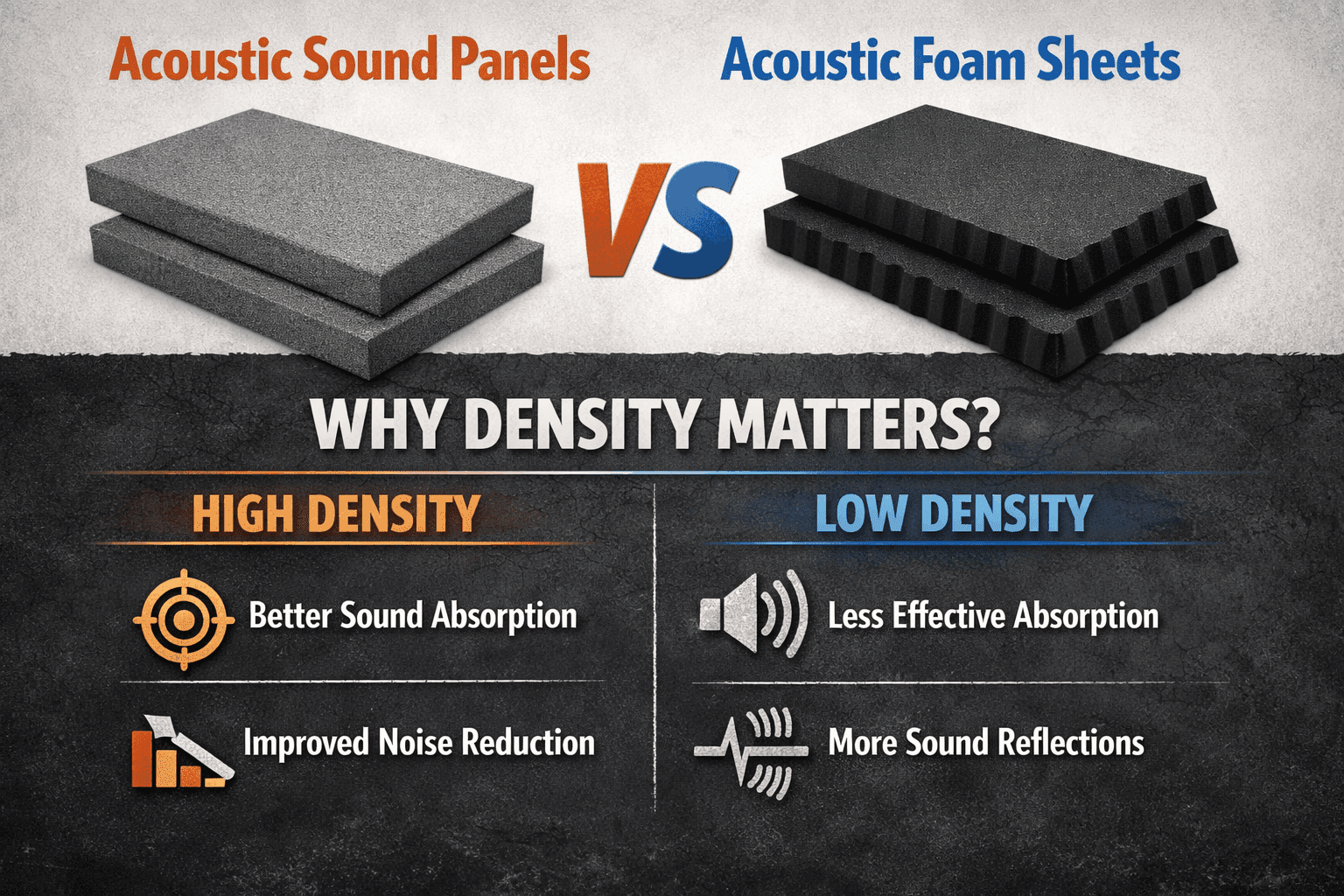
Why Density Matters in Acoustic Performance
Density determines how effectively a material converts sound energy into heat through friction within its structure.
- Higher density = broader frequency absorption + stable performance
- Lower density = limited frequency range + faster degradation
This is the core reason acoustic sound panels outperform acoustic foam sheets in demanding acoustic environments.
Key Effects of Density
- Frequency range coverage
Dense acoustic sound panels absorb both speech and ambient noise frequencies.
Low-density acoustic foam sheets mainly absorb treble reflections. - Sound penetration depth
In acoustic sound panels, sound waves travel deeper into fibers.
In acoustic foam sheets, absorption occurs mostly on the surface. - Consistency over time
Acoustic sound panels maintain structure and NRC.
Acoustic foam sheets can crumble or sag, reducing performance. - Acoustic efficiency per area
Fewer acoustic sound panels achieve target reverberation levels compared to larger coverage of acoustic foam sheets.
Side-by-Side Comparison: Acoustic Sound Panels vs. Acoustic Foam Sheets
Key Feature Comparison (Pointers)
Acoustic Sound Panels
- High-density core construction
- Absorbs mid and high frequencies effectively
- NRC performance remains stable long-term
- Durable and impact-resistant
- Wide aesthetic options (fabric, printed, textured)
- Often available with commercial fire ratings
- Easy surface cleaning and maintenance
- Typical lifespan: 8–15+ years
- Ideal for commercial and architectural spaces
- Higher upfront cost per m²
- Lower cost per acoustic performance over time
Acoustic Foam Sheets
- Low-density polyurethane or melamine foam
- Primarily absorbs high-frequency reflections
- NRC reduces with aging and deformation
- Moderate to low durability
- Limited visual options (wedge, pyramid shapes)
- Fire performance varies by product
- Difficult to clean (dust retention)
- Typical lifespan: 2–5 years
- Suitable for temporary or budget spaces
- Lower upfront cost per m²
- Higher cost per performance lifecycle
Pros and Cons
Acoustic Sound Panels – Pros
- Superior broadband absorption
- Reliable NRC for sound panels for walls
- Long lifespan and structural stability
- Design customization options
- Commercial fire ratings available
- Lower replacement frequency
Acoustic Sound Panels – Cons
- Higher initial investment
- Requires planned installation
- Heavier than acoustic foam sheets
Acoustic Foam Sheets – Pros
- Low upfront cost
- Lightweight and easy to mount
- Useful for quick echo reduction
- DIY friendly
Acoustic Foam Sheets – Cons
- Limited absorption spectrum
- Degrades faster than acoustic sound panels
- Dust accumulation issues
- Weak aesthetics for visible sound panels for walls
- Often unsuitable for high-end spaces
Scenario-Based Usage: Which Performs Better?
- Corporate Meeting Rooms
Goal: Speech clarity and reduced reverberation
Dense acoustic sound panels perform best because speech frequencies fall in mid-range bands. Acoustic foam sheets may reduce echo slightly but cannot achieve full clarity targets.
Recommendation: Acoustic sound panels
- Podcast or Recording Rooms
Goal: Echo control + tonal balance
Combination use is possible, but broadband absorption from acoustic sound panels stabilizes recordings more effectively than relying only on acoustic foam sheets.
Recommendation: Acoustic sound panels with selective foam accents
- Home Studios or Hobby Rooms
Goal: Budget acoustic improvement
If budget is tight, acoustic foam sheets can reduce flutter echo. However, upgrading later to acoustic sound panels significantly improves tonal balance.
Recommendation: Foam for temporary setups, panels for long-term
- Open Offices
Goal: Noise control + aesthetics
Visible sound panels for walls must perform acoustically and visually. Acoustic sound panels provide both; acoustic foam sheets often look utilitarian and degrade.
Recommendation: Acoustic sound panels
- Restaurants and Hospitality Spaces
Goal: Ambient noise reduction + décor integration
Durability, fire safety, and aesthetics are critical. Acoustic sound panels outperform acoustic foam sheets in all three aspects.
Recommendation: Acoustic sound panels
- Temporary Installations or Exhibitions
Goal: Short-term echo reduction
Here the low cost and lightweight nature of acoustic foam sheets may suffice. Long-term sound panels for walls are unnecessary.
Recommendation: Acoustic foam sheets
Performance Efficiency: Coverage vs. Result
Because density improves absorption efficiency, fewer acoustic sound panels are required to achieve target reverberation times compared with acoustic foam sheets.
Example:
- 30–40% wall coverage with acoustic sound panels
- 60–80% coverage with acoustic foam sheets
This difference directly impacts installation time, aesthetics, and total cost of ownership.
Durability and Lifecycle Cost
While acoustic foam sheets cost less initially, their shorter lifespan often leads to higher lifecycle cost compared to acoustic sound panels used as permanent sound panels for walls.
Foam Replacement Cycle
- Oxidation
- Crumbling
- Sagging adhesive
- Dust discoloration
Panel Longevity Factors
- Dense fiber core
- Stable thickness
- Fabric protection
- Structural rigidity
Over 10 years, replacing acoustic foam sheets multiple times can exceed the cost of installing acoustic sound panels once.
Aesthetic Integration in Interior Design
Modern interiors demand acoustic materials that blend seamlessly with architecture. Acoustic sound panels offer:
- Fabric colors
- Printed graphics
- Geometric formats
- Seamless wall systems
- Sculpted surfaces
In contrast, acoustic foam sheets are typically available in limited monochrome wedge or pyramid patterns, restricting design possibilities for premium sound panels for walls.
Fire and Safety Considerations
Commercial and institutional projects often require fire-rated sound panels for walls.
Many acoustic sound panels meet Class A or equivalent fire standards due to mineral or fiberglass cores.
Some acoustic foam sheets are treated for fire resistance, but performance varies and certifications are inconsistent across products.
For public spaces, dense acoustic sound panels are typically the safer specification.
Installation and Handling
Acoustic Sound Panels
- Mechanical fixing or track systems
- Professional installation recommended
- Precise layout alignment
Acoustic Foam Sheets
- Adhesive mounting
- DIY installation possible
- Flexible positioning
While foam offers ease, acoustic sound panels provide permanent alignment and stable geometry for architectural sound panels for walls.
Sustainability Considerations
Many modern acoustic sound panels use recycled PET or glass fiber cores, offering:
- Recycled content
- Low VOC emission
- Long service life
- Replaceable fabric skins
By contrast, acoustic foam sheets are typically petroleum-based polyurethane with limited recyclability and shorter usable life.
Thus, dense acoustic sound panels often deliver lower environmental impact per year of service.
Value-Driven Recommendation Matrix
Priority = Recommended Material
- Long-term acoustic performance = Acoustic sound panels
- Budget temporary treatment = Acoustic foam sheets
- Commercial interiors = Acoustic sound panels
- Aesthetic wall integration: Acoustic sound panels
- DIY acoustic improvement = Acoustic foam sheets
- Speech clarity spaces = Acoustic sound panels
- Short-term installations = Acoustic foam sheets
- Hospitality & retail = Acoustic sound panels
When Acoustic Foam Sheets Still Make Sense
Despite limitations, acoustic foam sheets remain useful in certain cases:
- Temporary recording booths
- Portable acoustic kits
- Budget classrooms
- Exhibition setups
- Prototype acoustic testing
However, for permanent sound panels for walls, dense acoustic sound panels provide measurable and lasting results.
The Core Insight: Density = Predictable Acoustic Results
Across architectural acoustics, one principle consistently holds true:
Higher density materials deliver broader absorption, longer lifespan, and better performance stability.
That is why acoustic sound panels are widely specified in commercial and institutional environments, while acoustic foam sheets remain secondary or temporary solutions.
Conclusion:
Acoustic Sound Panels vs. Acoustic Foam Sheets
When comparing acoustic sound panels and acoustic foam sheets, density emerges as the decisive factor influencing acoustic efficiency, durability, aesthetics, and long-term value.
While acoustic foam sheets provide economical echo reduction and easy installation, they lack the broadband absorption, structural stability, and lifespan required for permanent sound panels for walls in professional environments.
Dense acoustic sound panels, on the other hand, deliver predictable acoustic control across speech and ambient noise frequencies, integrate seamlessly with interior design, and maintain performance for years without degradation.
For architects, designers, contractors, and facility owners seeking reliable acoustic outcomes, acoustic sound panels represent the more efficient and future-proof investment compared with acoustic foam sheets.
Ultimately, choosing higher-density sound panels for walls ensures fewer materials, longer service life, and better acoustic comfort while making density the defining parameter in acoustic material selection.
Specify the Right Acoustic Solution for Your Space
If you’re planning interior acoustic treatment and evaluating acoustic sound panels or acoustic foam sheets, selecting the right density and configuration is crucial for achieving measurable results.
Connect with our acoustic specialists to assess your space, performance targets, and design intent and discover optimized sound panels for walls that balance aesthetics, durability, and acoustic efficiency.
Start your acoustic upgrade with confidence because the right density makes all the difference.