
Walk into a beautifully designed space with sleek walls, refined finishes, perfect lighting and yet, something feels off. Conversations echo. Noise travels. Focus drops. Comfort disappears.
What’s missing isn’t visible at first glance. It’s hidden inside the walls, ceilings, and surfaces are the science of acoustic treatment materials.
Sound is one of the most powerful yet underestimated elements of spatial design. Whether it’s an office, home theatre, classroom, studio, restaurant, or healthcare space, acoustics directly shape how people experience a place. And at the heart of effective sound control lies the right acoustic material for walls, ceilings, and partitions.
In this deep-dive guide, we uncover what’s really inside acoustic solutions, how they work, why they matter, and how choosing the right acoustic panels or acoustic sheet material can transform any environment from noisy chaos to calm clarity.
The Hidden Problem We All Ignore: Sound Chaos
Noise pollution is no longer limited to busy streets. It has entered offices, homes, schools, cafés, and even hospitals. Hard surfaces like glass, concrete, metal, and stone reflect sound endlessly, creating:
- Echo and reverberation
- Poor speech clarity
- Listening fatigue
- Reduced productivity
- Stress and discomfort
This is where acoustic treatment materials step in, not to block sound entirely, but to manage it intelligently.
What Are Acoustic Treatment Materials?
At their core, acoustic treatment materials are engineered solutions designed to absorb, diffuse, or control sound waves within a space. Unlike soundproofing (which prevents sound from entering or leaving), acoustic treatment focuses on improving sound quality inside the room.
These materials work by converting sound energy into heat energy through porous structures, fibers, perforations, or specialized cores. The result? Reduced echo, balanced acoustics, and enhanced comfort.
From acoustic material for walls to ceilings, baffles, and panels, each product is designed with a specific purpose and theory behind it.
Understand the Theory behind Acoustic Materials
Sound travels as waves. When these waves hit a hard surface, they bounce back. When they hit a soft, porous, or perforated surface, the sound energy enters the material and gets absorbed.
Key Acoustic Principles at Work:
- Porosity: Open structures allow sound waves to penetrate
- Density: Controls which frequencies are absorbed
- Thickness: Thicker materials absorb lower frequencies better
- Air gaps: Enhance sound absorption performance
This is why acoustic panels and acoustic sheet material are carefully engineered—not randomly designed.
Acoustic Material for Walls: Where Sound Control Begins
Walls are the largest reflective surfaces in any space. Choosing the right acoustic material for walls can instantly improve sound clarity and comfort.
Common Types of Wall Acoustic Materials:
- Fabric-wrapped acoustic panels
- PET felt panels
- Fiberglass acoustic panels
- Perforated wooden or metal panels
- Printed or decorative acoustic sheets
These materials absorb mid to high-frequency sound, reduce flutter echo, and enhance speech intelligibility while making them ideal for offices, meeting rooms, classrooms, auditoriums, and homes.
Acoustic Sheet Material: The Versatile Performer
If flexibility and customization matter, acoustic sheet material is a game-changer.
What Makes Acoustic Sheets Unique?
- Lightweight and easy to install
- Available in various thicknesses
- Can be cut, shaped, grooved, or printed
- Offers both functional and aesthetic value
Acoustic sheet material is often used in modular interiors, furniture backing, wall linings, and decorative applications where design freedom is essential without compromising performance.
Acoustic Panels are more than just Soft Boards
Most people think acoustic panels are just fabric-covered boards. In reality, they are precision-engineered systems.
Inside an Acoustic Panel:
- Core material: Fiberglass, mineral wool, PET fiber, or foam
- Facing layer: Fabric, perforated surface, or decorative laminate
- Backing: Reinforces absorption and stability
These layers work together to target specific sound frequencies, ensuring balanced acoustics. High-quality acoustic panels are tested for NRC (Noise Reduction Coefficient) values to ensure reliable performance.
Types of Acoustic Treatment Materials You Should Know
Understanding different acoustic treatment materials helps you make informed choices based on space and function.
- Fiberglass Acoustic Materials
Highly absorbent and widely used in professional spaces like studios and auditoriums.
- PET Acoustic Materials
Eco-friendly, durable, and ideal for modern interiors. Excellent as acoustic material for walls.
- Wood-Based Acoustic Panels
Combine warmth, aesthetics, and controlled perforation for balanced sound absorption.
- Metal Acoustic Panels
Engineered with perforations and backing layers—ideal for commercial and industrial spaces.
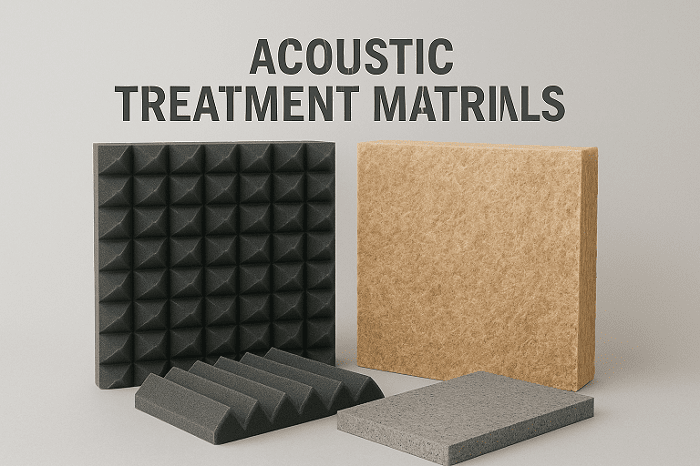
- Foam Acoustic Sheets
Cost-effective for specific applications but often limited to controlled environments.
Where Acoustic Treatment Materials Make the Biggest Impact
Still wondering if acoustic treatment is necessary? Consider these real-world scenarios:
- Offices: Better focus, fewer distractions, improved collaboration
- Homes: Clearer TV sound, peaceful living spaces
- Schools: Enhanced learning through improved speech clarity
- Restaurants & Cafés: Comfortable ambience without overwhelming noise
- Healthcare: Reduced stress, better patient recovery
- Studios & Auditoriums: Accurate sound performance
In each case, the right combination of acoustic panels, acoustic sheet material, and wall solutions changes how people feel in the space.
Design Meets Performance: A New Age of Acoustic Materials
Gone are the days when acoustic solutions looked dull or purely functional. Today’s acoustic treatment materials are:
- Visually striking
- Customizable in color, texture, and pattern
- Seamlessly integrated into interior design
- Brand-enhancing and expressive
From printed acoustic panels to sculpted wall forms, sound control is now a design feature—not a compromise.
Choosing the Right Acoustic Material for Walls: A Practical Guide
Before selecting any acoustic material for walls, ask these key questions:
- What type of noise needs control: speech, echo, or ambient sound?
- What is the size and function of the space?
- Are aesthetics as important as performance?
- Do you need sustainability or fire-rated compliance?
The best results come from combining technical performance with thoughtful placement—not just adding panels randomly.
Common Myths about Acoustic Treatment Materials
Let’s bust a few misconceptions:
- “More panels mean better acoustics.” Not always placement matters.
- “Acoustic panels make rooms silent.” They improve clarity, not silence.
- “Only studios need acoustic treatment.” Every space benefits from sound control.
- “All acoustic sheet material performs the same.” Performance varies by composition and design.
Understanding the theory behind acoustic treatment materials ensures smarter decisions and long-term results.
Real Value of Acoustic Treatment beyond Noise Control
Acoustic solutions don’t just fix sound—they improve experiences.
- Better communication
- Higher productivity
- Reduced stress
- Enhanced well-being
- Elevated design quality
In a world obsessed with visuals, acoustics remains the silent differentiator.
Conclusion: What’s Truly Matters?
You may not see it, but you’ll feel it.
Inside every high-performing space is a thoughtful combination of acoustic panels, acoustic sheet material, and purpose-driven acoustic treatment materials. When walls are designed to listen as much as they speak, spaces transform.
Whether you’re designing an office, upgrading a commercial interior, or enhancing a home environment, investing in the right acoustic material for walls isn’t optional anymore—it’s essential.
Ready to design spaces that sound as good as they look?
Explore advanced acoustic solutions, consult with experts, and choose materials that deliver both performance and design excellence. Because great spaces aren’t just seen but they’re heard.