
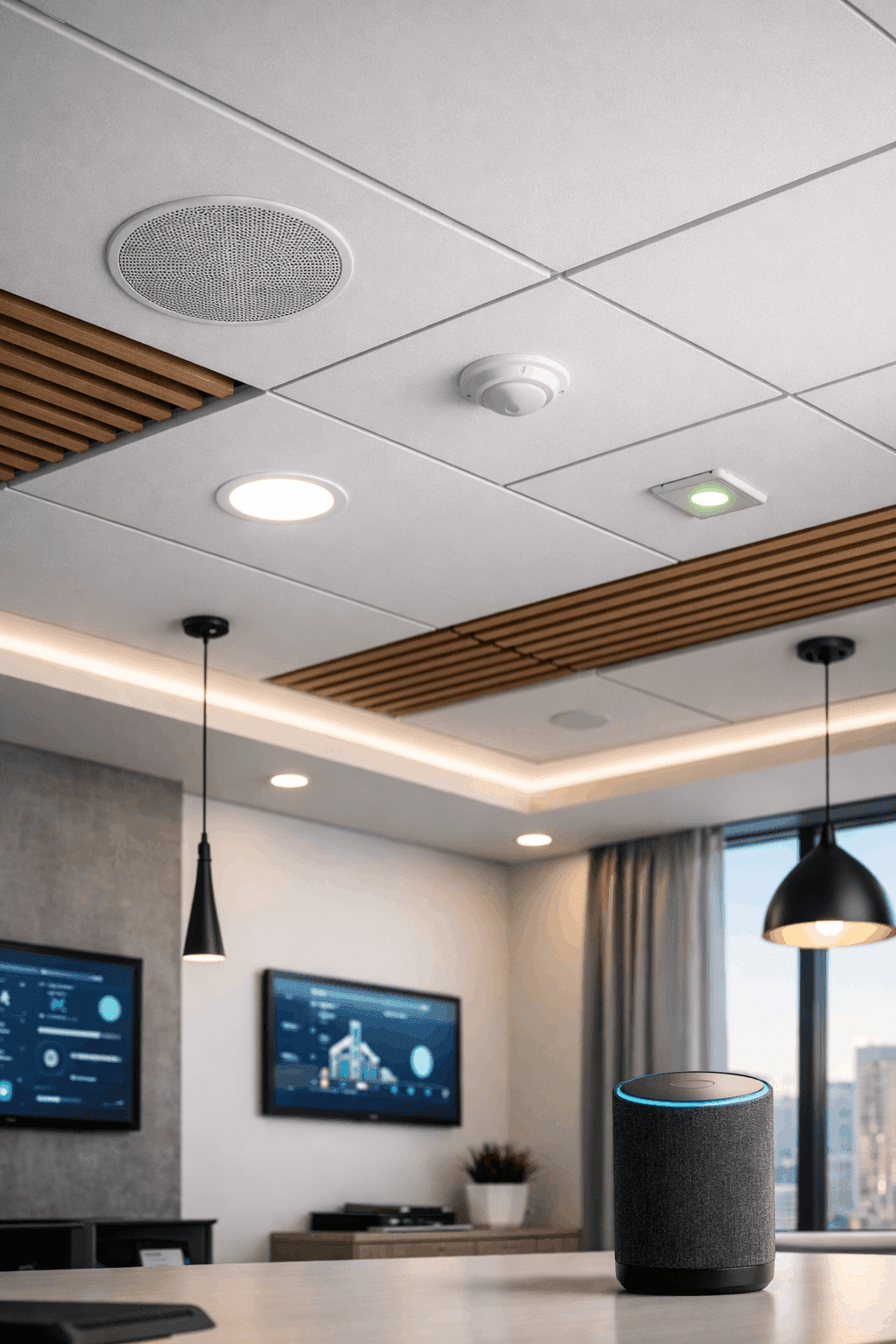
Ceilings are no longer passive surfaces. In contemporary architecture and interior design, the overhead plane has become a dynamic layer absorbing sound, delivering technology, and shaping visual identity simultaneously. This evolution has given rise to the concept of the “active” acoustic ceiling: a ceiling system that blends acoustic performance with integrated speakers, lighting, sensors, and digital infrastructure while maintaining design integrity.
For architects, designers, contractors, and facility planners, this shift represents an opportunity to rethink how sound control, user experience, and smart building functionality coexist. Instead of treating acoustic ceiling tiles, acoustic ceiling systems, and acoustic panels for ceilings as purely technical elements, active ceilings transform them into intelligent architectural assets.
This article explores how active acoustic ceilings work, why they matter, and how to integrate them seamlessly into modern built environments.
The Evolution from Passive to Active Acoustic Ceiling Systems
Traditional acoustic ceiling tiles were designed primarily for sound absorption reducing reverberation and improving speech clarity in offices, classrooms, and public interiors. While effective, these systems functioned as isolated layers, separate from lighting, HVAC, and AV technologies.
Active acoustic ceilings change this paradigm by embedding functionality directly into the acoustic ceiling system itself. Today’s ceilings can:
- Distribute sound via concealed speakers
- Sense occupancy, temperature, or air quality
- Integrate lighting and digital controls
- Conceal infrastructure without sacrificing access
- Enhance spatial aesthetics
This convergence of performance and intelligence aligns with the broader trend toward responsive, human-centric architecture.
What Defines an “Active” Acoustic Ceiling?
An active acoustic ceiling integrates acoustic absorption with technological and experiential functions. Instead of mounting devices onto a ceiling, the ceiling becomes the host platform.
Typical components embedded within acoustic panels for ceilings include:
- Distributed audio speakers
- Microphones for conferencing or voice control
- Motion and occupancy sensors
- Environmental sensors (CO₂, temperature, humidity)
- Linear or diffuse lighting systems
- Smart building connectivity
The result is a unified ceiling plane that manages acoustics, communication, and environmental responsiveness simultaneously.
Why Acoustic Ceilings Are Ideal for Technology Integration
The ceiling plane is uniquely positioned to host building technology. Integrating devices into acoustic ceiling tiles offers multiple advantages:
- Optimal Sound Distribution
Speakers embedded within an acoustic ceiling provide even audio coverage without visible hardware clutter. This is particularly beneficial in open offices, auditoriums, retail environments, and hospitality settings.
- Clear Sensor Field
Ceiling-mounted sensors achieve unobstructed coverage for occupancy detection, daylight harvesting, and environmental monitoring.
- Visual Minimalism
Integrating devices into acoustic panels for ceilings preserves clean architectural lines and reduces visual noise.
- Protection and Longevity
Ceiling integration shields technology from tampering, dust, and accidental damage common with wall-mounted devices.
Acoustic Performance Still Comes First
A common misconception is that adding technology compromises sound absorption. Well-designed active ceilings maintain or even enhance acoustic performance.
Modern acoustic ceiling tiles achieve high Noise Reduction Coefficient (NRC) values through:
- Porous mineral or fiberglass cores
- Micro-perforated surfaces
- Fabric-wrapped absorptive layers
- Hybrid absorptive-diffusive geometries
Technology modules are positioned or isolated so they do not interrupt acoustic pathways. In some designs, perforated speaker covers even contribute to sound absorption.
Applications of Active Acoustic Ceiling Solutions
- Smart Workspaces
Open offices benefit significantly from active acoustic ceiling systems. Integrated speakers enable sound masking or zoned audio, while sensors adjust lighting and HVAC based on occupancy. Acoustic absorption reduces distraction and improves focus.
- Hybrid Meeting Rooms
Video conferencing demands both sound clarity and discreet technology. Acoustic panels for ceilings can embed microphones, speakers, and cameras while maintaining uniform ceiling aesthetics.
- Healthcare Environments
Hospitals require calm acoustics and hygiene-friendly surfaces. Active acoustic ceiling tiles can integrate nurse call audio, ambient soundscapes, and environmental monitoring without visible equipment.
- Retail and Hospitality
Brand experience often relies on sound and ambiance. Active ceilings distribute music evenly and integrate lighting scenes while maintaining design continuity.
- Education and Learning Spaces
Speech intelligibility is critical in classrooms. Active acoustic ceiling systems combine absorption with distributed audio, ensuring every student hears clearly.
Design Strategies for Integrating Speakers into Acoustic Ceilings
Audio integration is one of the defining features of active ceilings. Successful implementation depends on both acoustic and aesthetic alignment.
Flush Integration
Speakers are installed behind perforated or fabric-wrapped acoustic ceiling tiles, remaining visually invisible while maintaining sound transparency.
Pattern Alignment
Speaker positions follow the modular grid or pattern of acoustic panels for ceilings, preserving visual rhythm.
Zonal Audio Planning
Different ceiling zones deliver distinct sound levels or content useful in open offices or retail spaces.
Vibration Isolation
Speaker mounts are acoustically decoupled to prevent structure-borne noise transfer.
Sensor-Enabled Acoustic Ceiling Systems
Sensors embedded within acoustic ceiling systems transform interiors into responsive environments.
- Occupancy and Motion: Ceiling-mounted sensors track presence, enabling adaptive lighting, HVAC control, and space utilization analytics.
- Environmental Monitoring: Integrated sensors measure temperature, humidity, and CO₂ levels, improving indoor air quality management.
- Smart Building Connectivity: Active acoustic ceiling tiles can act as nodes in IoT building networks, supporting automation platforms.
The advantage of ceiling integration lies in coverage accuracy and unobtrusive placement.
Lighting Integration within Acoustic Ceiling Tiles
Lighting is another essential component of active ceilings. Integrating luminaires into acoustic ceiling tiles produces both acoustic and visual harmony.
Linear Lighting Channels
Continuous light strips embedded within the acoustic ceiling grid provide uniform illumination.
Backlit Acoustic Panels
Translucent or perforated acoustic panels for ceilings can be backlit, creating luminous ceiling fields.
Acoustic Baffle Lighting Hybrids
Suspended acoustic baffles combine sound absorption with integrated lighting modules.
These solutions eliminate conflicts between acoustic performance and lighting layout.
Aesthetic Opportunities: When Technology Becomes Invisible
The most successful active acoustic ceilings conceal complexity behind simplicity. Instead of visible speakers and sensors, the ceiling appears as a cohesive architectural surface.
Design possibilities include:
- Parametric acoustic patterns with hidden audio
- Sculpted ceiling clouds containing sensors
- Monolithic fabric ceilings with integrated lighting
- Perforated metal acoustic ceiling systems with embedded devices
In each case, acoustic ceiling tiles or panels become both finish and infrastructure.
Material Considerations for Active Acoustic Ceilings
Material selection influences both acoustic performance and integration feasibility.
Fiberglass Acoustic Panels
Lightweight, highly absorptive, and easy to perforate is ideal for embedding speakers and sensors within acoustic panels for ceilings.
Mineral Fiber Acoustic Ceiling Tiles
Common in commercial grids; compatible with integrated lighting and audio modules.
Metal Acoustic Ceilings
Durable and precise; perforations allow sound absorption while housing technology components.
Wood Acoustic Panels
Provide warmth and biophilic aesthetics while accommodating concealed devices.
Each material supports active integration differently, but all maintain the functional role of the acoustic ceiling.
Installation and Coordination: The Key to Success
Active acoustic ceilings require multidisciplinary coordination between architects, acoustic consultants, AV designers, MEP engineers, and contractors.
Critical considerations include:
- Module sizing and grid alignment
- Access for maintenance
- Cable routing within ceiling voids
- Acoustic continuity across device zones
- Structural support for integrated components
When planned early, acoustic ceiling tiles and technology elements align seamlessly. Late integration often leads to visual disruption and acoustic compromise.
Maintenance and Lifecycle Benefits
Integrating devices into acoustic ceiling systems improves long-term performance and maintenance.
Simplified Access
Removable acoustic ceiling tiles allow easy access to embedded devices.
Reduced Clutter
Fewer exposed fixtures reduce cleaning and damage risks.
Upgradeable Modules
Technology components within acoustic panels for ceilings can be replaced without altering the entire ceiling.
Durability
Protected placement extends device lifespan.
These advantages make active ceilings attractive for large facilities and long-term projects.
The Human Experience: Why Active Acoustic Ceilings Matter
Beyond technology and aesthetics, active acoustic ceilings improve how spaces feel and function.
- Clearer speech and reduced noise fatigue
- Even, comfortable sound distribution
- Adaptive lighting and environmental comfort
- Visually calm interiors
- Seamless digital interaction
By merging acoustics and intelligence, the acoustic ceiling becomes a contributor to wellbeing rather than a background element.
Future Trends in Active Acoustic Ceiling Design
The next generation of acoustic ceiling tiles and panels will likely incorporate:
- AI-driven occupancy analytics
- Adaptive acoustic tuning
- Integrated air purification
- Interactive lighting and soundscapes
- Fully modular smart ceiling systems
As buildings become more responsive, the acoustic ceiling will function as an environmental interface rather than a static surface.
Conclusion
The rise of active acoustic ceilings marks a fundamental shift in how ceilings are designed and perceived. No longer limited to sound absorption, acoustic ceiling tiles, acoustic ceiling systems, and acoustic panels for ceilings now host audio, sensing, lighting, and smart infrastructure within a unified architectural plane.
For designers and specifiers, this integration offers a powerful opportunity: to deliver acoustic comfort, technological capability, and visual clarity simultaneously. The ceiling evolves from a passive background into an intelligent, performance-driven layer of the built environment.
If you’re planning a workspace, commercial interior, or institutional project, consider how an active acoustic ceiling strategy can elevate both performance and experience. Integrated acoustic ceiling tiles and acoustic panels for ceilings can transform ceilings into responsive, aesthetically refined systems that support modern architecture and user wellbeing.
Explore advanced acoustic ceiling solutions that seamlessly integrate sound, technology, and design because the smartest spaces start from the top.